
A Small Book With a Big Cooperative Imagination: Reflections and the Legacy of Mondragon
Some books are meant to explain a movement from the outside. Others feel like they were written from inside the workshop, close to the people trying to build something better with their own hands.
Reflections: Insights from the Founder of the Mondragon Cooperatives belongs in the second category.
Published by Solidarity Hall, the project founded by RMEOC Social Cooperative Program Director Elias Crim, Reflections gathers the practical and philosophical insights of Fr. Josemaria Arizmendi, the Basque priest whose work helped launch the Mondragon cooperative movement. It is a compact book, but its subject is large: how work, education, ownership, and community can be organized around human dignity rather than extraction.
For anyone interested in employee ownership, worker cooperatives, or social cooperatives, Arizmendi's life remains one of the most important examples of what cooperative development can look like when it is rooted in both patience and ambition.
Why Arizmendi still matters
Arizmendi arrived in Mondragon after the Spanish Civil War, in a community marked by poverty, political repression, and limited economic opportunity. He did not begin with a business plan. He began with education.
That point matters. Before the first cooperative factory, there was a technical school. Before a network of worker-owned firms, there was a commitment to preparing ordinary people to participate in shaping their own economic future.
This is one reason Arizmendi's work continues to resonate with cooperative developers today. His vision was not simply that workers should own shares. It was that the workplace itself could become a school of personal and community transformation.
The Solidarity Hall product page describes Reflections as a collection of insights and practical wisdom compiled from Arizmendi's writings, originally published as Pensamientos and now presented in English for a new generation of cooperative readers. That framing is exactly right: the book is not a manual in the narrow sense, but it is deeply practical. It asks readers to think about what kind of people, institutions, and communities cooperative ownership is meant to form.
A bridge between Mondragon and today's solidarity economy
Mondragon is often cited as proof that worker ownership can scale. Today, the Mondragon Corporation operates across five continents and employs more than 80,000 people. But the deeper lesson is not just scale. It is culture.
Cooperatives do not succeed because ownership is placed on paper and left there. They succeed when education, governance, accountability, and solidarity become part of daily practice.
That is where Reflections is especially useful. Arizmendi's short meditations keep returning to the human side of economic life: the dignity of work, the responsibility of participation, the limits of capital, and the importance of building institutions that help people grow.
For RMEOC, those questions are not abstract. They are central to our work with business owners, workers, caregivers, community leaders, and cooperative organizers across Colorado. Whether the model is an ESOP, worker cooperative, employee ownership trust, or emerging social cooperative, the core question remains the same: how do we build enterprises where people have a real stake and a real voice?
Why this book belongs in the RMEOC conversation
Elias Crim's work with Solidarity Hall and his leadership in RMEOC's Social Cooperative Program share a common thread: a belief that cooperative institutions can help communities meet real social needs.
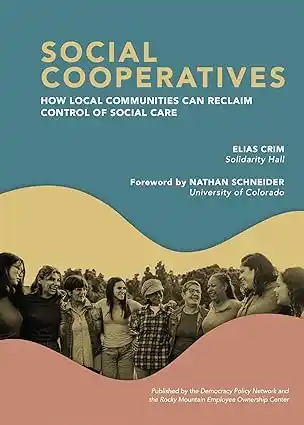
Social cooperatives are especially relevant here. Around the world, social co-ops have been used to organize care work, community services, employment pathways, and local social infrastructure through democratic ownership. They ask a practical question: what if the people providing care, receiving care, and supporting the work could help govern the enterprise together?
That question fits naturally beside Arizmendi's vision. Both point toward an economy where ownership is not only financial, but civic and relational. Both suggest that communities can build durable institutions when they combine technical assistance, democratic participation, and a clear commitment to the common good.
Reflections is a short book, but it opens a wide door. For business owners thinking about succession, it offers a reminder that a transition can preserve more than jobs; it can preserve purpose. For workers, it offers language for the dignity and responsibility of ownership. For cooperative organizers, it offers a source of orientation when the work gets complicated.
And for Colorado's employee ownership community, it offers a link between one of the world's most influential cooperative stories and the work happening here now.
Read the book
If you are exploring employee ownership, cooperative development, or the future of social care, Reflections is worth keeping close. It is a small book with a large invitation: to imagine work as a place where people build capacity, community, and shared prosperity together.
Learn more or order Reflections from Solidarity Hall: https://solidarityhall.org/product/reflections/
Kindle edition: https://www.amazon.com/dp/B0H3CP4K63
 English
  Spanish