Clegg Auto
Clegg Auto EOT leads a coalition of multiple EOT companies, together benefiting over 100,000 employees. They offer higher than industry standard wages, and health and retirement benefits to all employees.
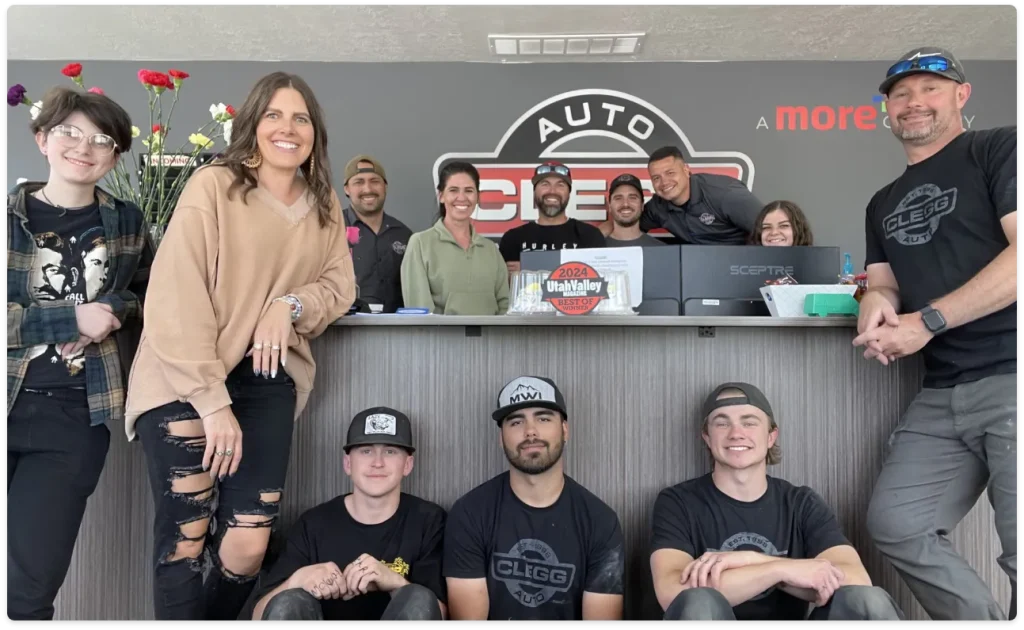
The owners of Clegg Auto Repair Services in Utah chose to restructure the company into an Employee Ownership Trust in 2022. Since then, Clegg Auto has demonstrated how the stewardship trust model can uplift employees, and serve communities—all while dramatically increasing profits.
Between undergraduate and graduate school, Kevin Clegg, CEO of Clegg Auto, and Daron Jones, Vice President of Operations, started an auto repair business. Afterward, Kevin returned to school and earned a graduate degree in Organizational Behavior. Upon finishing graduate school, he gained professional experience at some of the most prominent companies in the country: “[I] went to work with lots of big Fortune 500 companies, Jacuzzi, Pulte Homes, USAA, Honeywell…” Kevin’s brother, Daron Jones, also earned a Master’s in Organizational Behavior, and was driven by the “goal to create environments and cultures where people could reach their full potential in a professional way.” In 2020, Daron Jones reached out to his brother with a proposition about an auto shop he ran: “I don’t know how to grow this thing… come do it with me,” Kevin agreed, on one condition: “We’ll sell it to [our] employees when we’re done.” The two joined forces—bringing their shared vision of values-centered business to life.
By the time Kevin rejoined his brother’s operation, Clegg Auto had grown into a multi-site operation with “two more service shops, a body shop, and a sales lot.” The brothers had long imagined selling the business to employees as a retirement plan, but then, Kevin recalled, “something clicked… this isn’t an exit strategy, this is an operating model.” After a decade spent building a values-driven, family-run enterprise, they weren’t ready to cash out–they wanted to codify what they had built.
Over the next two years, Kevin and Daron researched employee ownership models that could protect the company’s culture while embedding a long-term vision. “I learned the specifics of what an ESOP was, and realized that was a nonstarter,” Kevin notes, referring to the burdens associated with cost, management, and valuation requirements associated with ESOPs. Additionally, Daron and Kevin were concerned that an ESOP could eventually be sold back into conventional ownership – running counter to the intention of keeping Clegg Auto employee-owned in perpetuity.
Reflecting on his professional experience prior to Clegg, Daron understood the potential consequences of an acquisition:“I can’t work in a model that that would be the case, that supposedly what’s in the best interests of employees would allow you to sell a thing to where they don’t even have a job anymore, potentially.”
CLEGG EOT: EMPLOYEE BENEFIT & SOCIAL PURPOSE
- Company profits jumped from $500,000 to $1.3 million one year after transition.
- Profit-sharing model and Above average wages for auto repair industry
- 401(k) retirement plan with matching contributions for all employees
- Custom health benefits plan
- 10% of profits to charity: half local, half global
- Support for local residents unable to afford car repairs.
“We have purposes, we are trying to hold on to them: we’d like to see businesses last in perpetuity, and we want to make sure that purposes like treating people like owners, sharing profits, help people find what matters most to them, and support them in those journeys.”
“There are people that care. There are jobs that matter, you can make a difference, and you matter.”
“As much as I”m pro employee ownership, I’m pro community...We live in the most connected world ever, and yet we truly don’t build much together. So why not start now?”
– Kevin Clegg, CEO
THE EMPLOYEE OWNERSHIP TRUST (EOT) MODEL
With the help of Common Trust, a nonprofit focused on purpose trust transitions, Clegg Auto built its EOT on the legal foundation of a Perpetual Purpose Trust, an arrangement that would allow their vision to be held in trust indefinitely.
Under the EOT structure, Clegg employees gained access to profit-sharing, a voice in governance, and new opportunities for growth and development. The company created an internal employee development curriculum that, in Kevin’s words, “helps people understand how to own their lives, their careers, and their company.”
The goal wasn’t merely to retain talent, but to help people find alignment between their lives and their work: “we’re not focused on retention, we’re focused on helping people discover what it is that they want from life and doing something about it,” Kevin said. “Whether that’s, ‘I need some schooling,’ or ‘I need some connections to another company,’ we would look at how we might accommodate as best we could as a company.”
Shared Struggle: Shared Prosperity
“We have four businesses, three of the businesses were profitable, one of the businesses was not, so we started asking questions… do you just want to share profits within your own business? Or do you want to share it collectively knowing that the business that wasn't doing well is decreasing the profits for everybody else? And in this case, the managers decided that we were all a big family. So even though the one shop's profits dropped everybody else's down, they wanted everybody to share in the profits, even the business that wasn't profitable.”
– Daron Clegg, VP of Operations
“ BUILT TO GROW ”
As CEO Kevin Clegg describes, their EOT has a goal to creating an “easy button” for additional small business owners to transition to employee ownership, “to protect not only their legacy, but to protect their customers and their employees as well.” Through acquiring more enterprises through the trust, the team at Clegg are inspired to build a coalition of values-dedicated businesses and reward the cohort of retiring small business owners: “our vision is to help 10,000 small businesses transition to employee ownership in the next ten years”
On the road to achieving this goal, many of the small business owners that Daron and Kevin have met make up the “Silver Tsunami” of retiring baby boomers. “Most businesses don’t have a succession plan,” Daron stated, “Even if there’s an affordable structure… What's the succession of leadership? ”
Their long-term hope at Clegg is to connect with many of these retiring business owners and foster a growing alliance of employee-owned businesses ones that retain their independence, but align around a shared purpose and stewarding ethos.
Kevin describes his vision of a kind of next generation holding company or shared services platform that supports decentralized ownership with centralized purpose. The team at Clegg dream of “designing and building a structure that aligns on a common purpose, and lets people run it independently through their own C corp, so financially, we can’t impact each other, but we're aligned by purpose so that we're building something bigger than ourselves.”
When asked about the future, Daron reflects on how quickly their EOT model has grown. “On July 23rd, 2025… We just got word from one of our holding companies that they’re bringing in a couple other businesses, and as our calculations start coming in, we recognize that we will eclipse the goal of blessing 100,000 employees' lives with the latest acquisition.” Daron adds that “not only that, but thousands of communities across the US now understand and are voting with their feet to take business to employee owned companies,”
THE STEWARDISTS
Kevin and Daron describe themselves as “stewardists,” a fitting term that expresses the deep moral purpose behind their work. Clegg’s Stewardship model subverts the proverbial private equity acquisition pattern:“I feel like some form of rollups, like private equity, but done by an EOT, could be extremely powerful,” Kevin notes.
The Stewardists imagine a future where employee ownership becomes the vehicle through which everyday businesses, the anchor of local communities, are preserved, scaled, and connected. In a world where private equity often extracts value and relocates wealth, they see EOTs as a way to “roll up” businesses – not for control, but for care. “I’m kind of sick and tired of the selfish nature of business, like, why do we have to protect what’s good for people and make money on it instead of making it accessible… What if business was about like minded people coming together?” Clegg’s transformation wasn’t simply about transforming a single enterprise, therefore, it was about building a new model for the economy. “Let’s start envisioning ways that we do more together as a business, let’s actually make a difference.
The results of this model have been profound. The EOT has transformed Clegg’s internal culture, aligning financial incentives with shared purpose. As one employee-owner put it, they “no longer work for somebody I don’t see, who then takes all the profits…I know that if I put an extra effort, I could be rewarded for those things, and I like the people that I work with and [we’re] aligned with common objectives.”
 Spanish
  English