
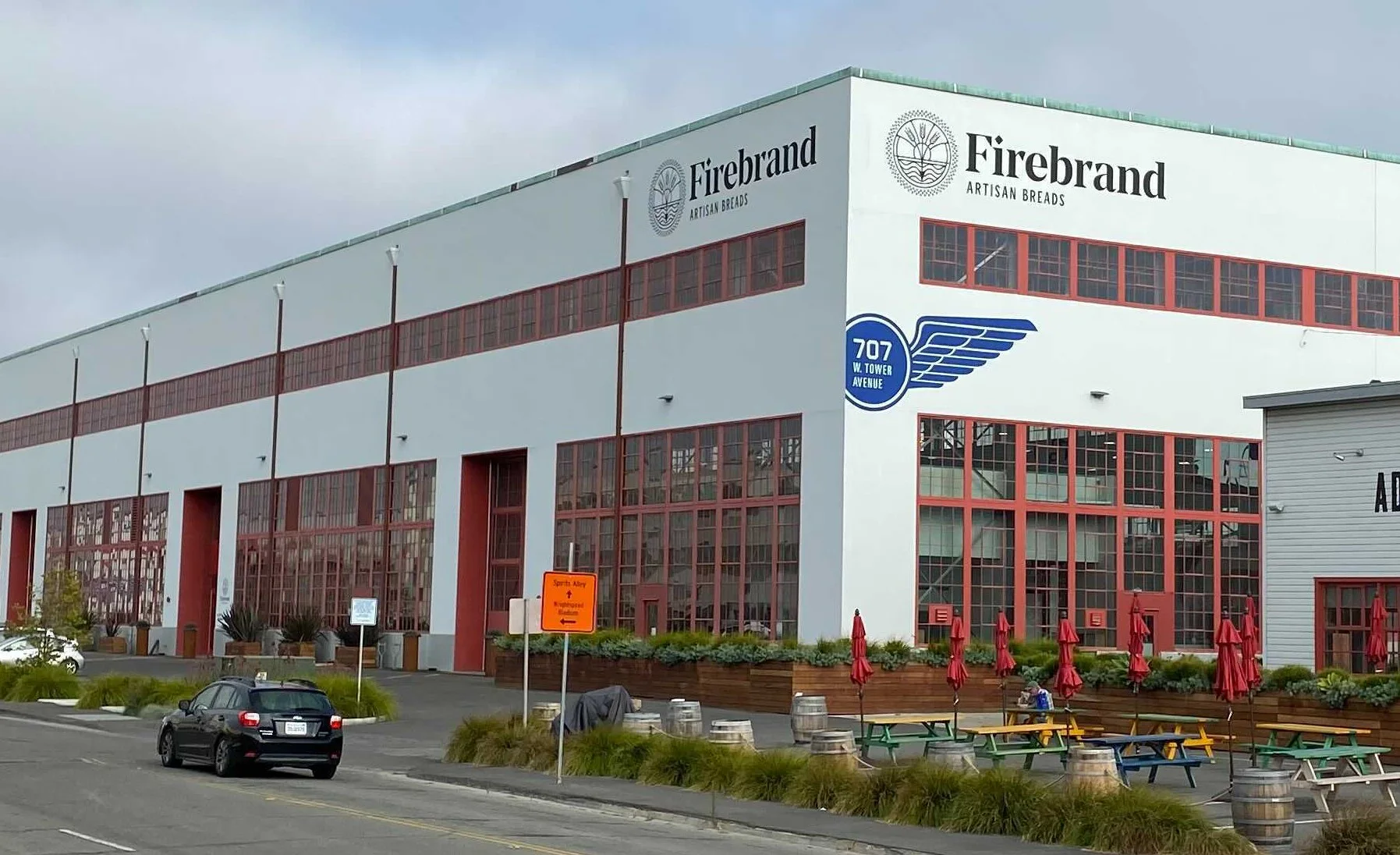
Firebrand Artisan Breads
Firebrand Artisan Breads shows how a company with a social mission can take steps to ensure that its mission to serve the community and provide good jobs for those with barriers to employment continues as long the enterprise survives.
Matthew Kreutz’s dream had always been to work for himself, based on his lifetime commitment to “DIY (Do It Yourself) ethics” that is common in the lifestyle of punk subculture. Consequently, in 2008, Kreutz founded Firebrand Artisan Breads in a West Oakland warhouse. In the beginning, there were no goals other than keeping the store afloat for a few years. This goal required “emotionally and physically demanding work with long hours in an industry marked by high turnover, limited career opportunities, and little to no safety net for workers.” In 2012, Firebrand began to offer 24-hour delivery service, and the business grew exponentially after that. By 2018, there were 55 employees, 80% of whom were people of color, and 60% of all managers were women. “I was more interested in hiring more vulnerable people,” Kreutz recalls. “ We did not require any resume or anything, but we welcomed anyone who was willing to work hard.”
In 2020, Kreutz began to consider a stewardship trust model which could protect Firebrand’s social mission into the future, while attracting value-aligned investors. “It took me 48 hours to decide to go with a perpetual purpose trust” stated Kreutz, as it provided a way to secure his social values regardless of who specifically invested in or managed the business.
“I can get hit by a car, but the company continuing with its mission without any external pressure was important for me.” stated Kreutz. “Baking is a conduit through which we offer marginalized people an equitable workplace,” Kreutz notes, and a perpetual purpose trust is a way of ensuring that this mission never changes and that the company can’t be sold to larger investors, no matter the profits.
“It was always a natural and organic thing for us. I’ve never wanted to work at a place where I felt like I couldn’t be myself. I’ve also been around a lot of people that don’t have the fanciest education or most privileged background who can just kill it. Where their backgrounds were a real advantage, not on paper, but in real life, they add a huge amount to the company.”
-- Matthew Kreutz, Founder Firebrand Artisan Breads
DIGNIFIED WORK FOR VULNERABLE POPULATIONS
- Firebrand’s EOT Trust Agreement specifies perpetual social purpose goals, such as; 1) “prioritizing the hiring of people who are formerly incarcerated, homeless, or otherwise have high barriers to entering the workforce” 2) “maintaining a profit-sharing program” 3) prioritizing “professional development of employees as well as increasing growth ladders” and 4) promoting “fair labor practices.”
- 80% workers are formerly incarcerated or homeless people.
- Employees offered business management and personal development workshops.
- Employees connected to social services, including legal assistance, housing assistance, ESL and GED classes.
- Employees enjoy, free health care, dental, and vision benefits.
“Firebrand seeks to stand at the center of a new wave of capitalism that leverages business to address complex societal problems.”
“We believe through business we can create shared value for employees and the community”
– Matthew Kruetz, Founder
( www.purpose-economy.org/content/ uploads/purpose-firebrand-artisan breadscase-study.pdf)
COOP, ESOP, OR EOT?
To secure his values-driven mission, Kreutz considered other employee ownership models, such as worker cooperatives and ESOPs. However, Kreutz believed a worker cooperative works best in a small workspace and Firebrand was growing quite large. Also, his focus was less on providing “ownership” to employees, and more on maintaining the social mission of vulnerable workforce development, while also growing over the next 10 years so as to provide more jobs to marginalized community members. So Kreutz eliminated the option of a worker co-op.
Kreutz did not consider the ESOP model the right fit either, because employees must remain with ESOPs for a lengthy period of time to become vested in stock or retirement benefits, while many employees in the bakery and café industry have short retention periods. Also, the ESOP model is largely driven by the promise of stock gains and retirement benefits to employee stockholders, and this monetary motivation did not match Kreutz’s hope to sustain a social mission-driven focus at Firebrand.
Thus, Kreutz believed the best way to continue to grow his bakery business would be to ensure professional management and outside investor interest in a steward-managed employee ownership trust. In so doing, he avoided the complicated process of an ESOP conversion. Firebrand incorporated as a perpetual purpose trust in August 2021. The entire process from start to completion took just eight months. Detailed worker engagement was not part of the conversion process, and it was only after completing the conversion, that Kreutz informed workers of the new Employee Ownership Trust model.
FIREBRAND EOT: CONVERSION PROCESS
- Started in 2020, assisted by law-firm specializing in trust law. Conversion completed in 8 months.
- Social purpose trust agreement establishes 5 member Trust Stewardship Committee: 3 from Firebrand (including company founder), 1 community member (a supportive foundation) and 1 independent member.
- Before conversion, founder Kreutz owned 100% of shares. After conversion, Firebrand Stewardship Trust owns 33% of shares, the founder (Kreutz) owns 30%, two social impact investment groups own 29%, and employees own 8%.
- Social mission and investor return is balanced through a profit structure in which “patient capital” investors receive 90% of the distributed profits until they have achieved 2X their initial investment. The remaining 10% of profits are distributed to employees. Once investors achieve 2X their initial investment, the profit structure is flipped and investors only receive 10% of profits, while the remaining 90% is distributed pro-rata based on ownership.
- As investors are redeemed, their original shares are bought back at original face value and allocated to the Firebrand Perpetual Trust.
“Our mission is to create a more just and equitable workplace, shared value, and thriving communities through the craft of baking. This concept of ‘shared value’ really resonated with me, and it aligns with steward ownership principles. How do we create a company where it’s not a top-down system, where everyone adds value and the company returns that back to the employees. How can we make sure that all our stakeholders in the company actually win?”
If Firebrand is successful, our stakeholders (employees) are successful and everyone shares. How do we build that up? And then what does that mean? That could mean great wages, fully paid healthcare, and a good workplace. Maybe in a couple of years, we're helping out with housing assistance and we're leaning into other areas like childcare.
What does it mean for us to provide shared value to our staff? How do we build a culture and team where everyone is valued and thriving? These are things we focus on all the time, how can we get better and make Firebrand a better place. I want Firebrand to be like an old-school factory job, where you can build a life from it, you can buy a house, have retirement savings, build real wealth and skills that transfer out to the community.”
-- From “An Interview with Matt Kreutz of Firebrand Artisanal Breads.” Sustainable Food and Agriculture Perpetual Purpose Trust.
 English
  Spanish